iPod 5th Generation (2005): History and Specs
Introduction and naming
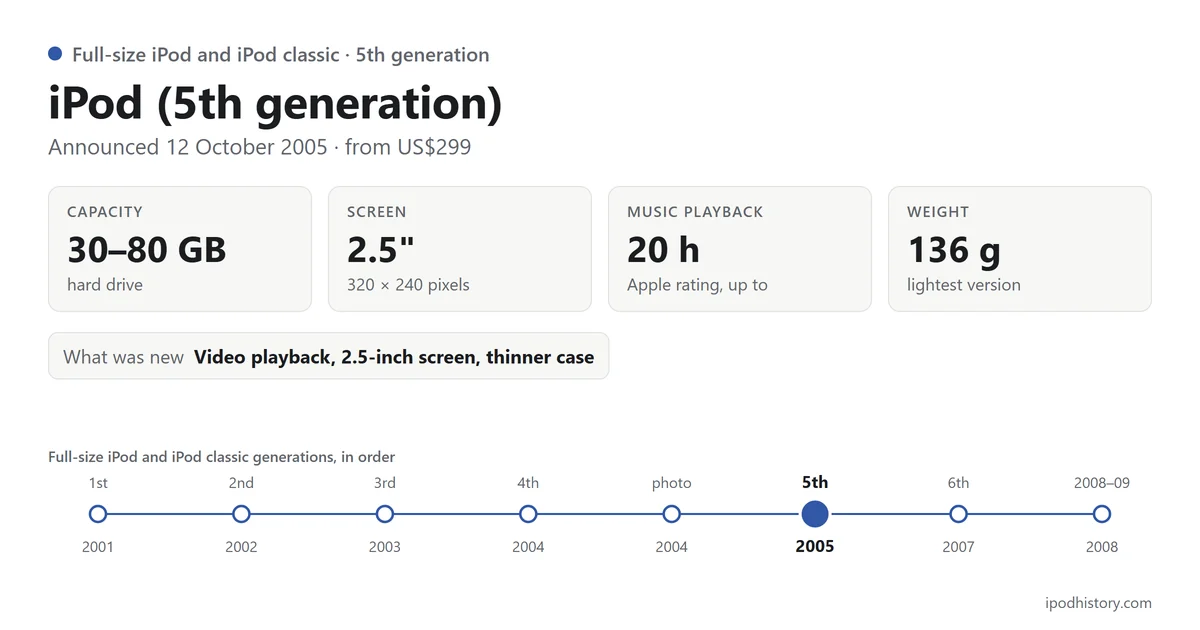
Apple announced the fifth-generation iPod on 12 October 2005 in San Jose and said it would ship the following week. It came in white or black, in 30 GB (US$299) and 60 GB (US$399) versions, and was the first iPod able to play video. It was sold simply as the iPod and is often called the "iPod with video"; the "classic" name belongs to its 2007 successor.
What changed from the fourth generation and iPod photo
Apple said the new model was 30 per cent thinner than its predecessor and offered 50 per cent more storage. The 30 GB version measured 4.1 × 2.4 × 0.43 inches and weighed 4.8 ounces; the 60 GB version was 0.55 inch deep and weighed 5.5 ounces. The screen grew to 2.5 inches with a 320 × 240 QVGA resolution and more than 65,000 colours, compared with 2 inches and 220 × 176 pixels on the iPod photo. The Click Wheel was smaller, a black finish joined white, and this was the last full-size iPod with a plastic front. The 4-pin remote port beside the headphone jack was removed. Syncing ran over USB, with FireWire used only for charging. Apple rated the 30 GB model at up to 14 hours of music and 2 hours of video, and the 60 GB model at 20 and 3 hours.
The late-2006 update
On 12 September 2006 Apple revised the model, a version often called the "enhanced" or "5.5-generation" iPod. An 80 GB version replaced the 60 GB model, and prices fell to US$249 for 30 GB and US$349 for 80 GB. The display became 60 per cent brighter and gained a brightness control, a Search feature with Quick Scroll was added, and redesigned earphones were included. Video playback rose to 3.5 hours on the 30 GB model and 6.5 hours on the 80 GB model, which was rated at 20 hours of music. The revision also supported games bought from the iTunes Store and gapless playback with iTunes 7. Earlier that year, on 6 June 2006, Apple had released a 30 GB iPod U2 Special Edition at US$329.
Successor
On 5 September 2007 Apple replaced the fifth-generation iPod with the iPod classic, offered in 80 GB (US$249) and 160 GB (US$349) versions in an anodised aluminium and polished stainless steel case.
Specifications
| Announced | 12 October 2005 |
|---|---|
| Launch price (US) | US$299 (30 GB), US$399 (60 GB); from September 2006 US$249 (30 GB), US$349 (80 GB) |
| Capacity | 30 GB or 60 GB hard drive; 30 GB or 80 GB from September 2006 — up to 20,000 songs |
| Display | 2.5-inch colour LCD, 320 × 240 pixels; 60 per cent brighter from September 2006 |
| Battery | 30 GB: up to 14 hours of music, 2 hours of video (3.5 hours from 2006); 60 GB: 20 and 3 hours; 80 GB: 20 and 6.5 hours |
| Connectors | Dock connector (USB 2.0), 3.5 mm headphone jack with composite video out |
| Size | 104 × 61 × 10.9 mm (4.1 × 2.4 × 0.43 in); 60 and 80 GB: 14 mm (0.55 in) deep |
| Weight | 136 g (4.8 oz); 60 and 80 GB: 156 g (5.5 oz) |
| Colours | White or black |
| Works with | Mac OS X 10.3.9 or later; Windows 2000 (SP4) or XP (SP2) |
Figures from Apple's published technical specifications. Where Apple lists only inches and ounces, metric values are converted and rounded.
How to identify it
- A flat front with a wide 2.5-inch colour screen and a smaller Click Wheel, in white or black.
- Only a headphone jack and Hold switch on top — no remote connector.
- The Late 2006 version's serial number ends in V9K, V9P, V9M, V9R, V9L, V9N, V9Q, V9S, WU9, WUA, WUB, WUC or X3N.
Where to find the model number and serial number: how to identify a used iPod.