iPod classic 6th Generation (2007): History and Specs
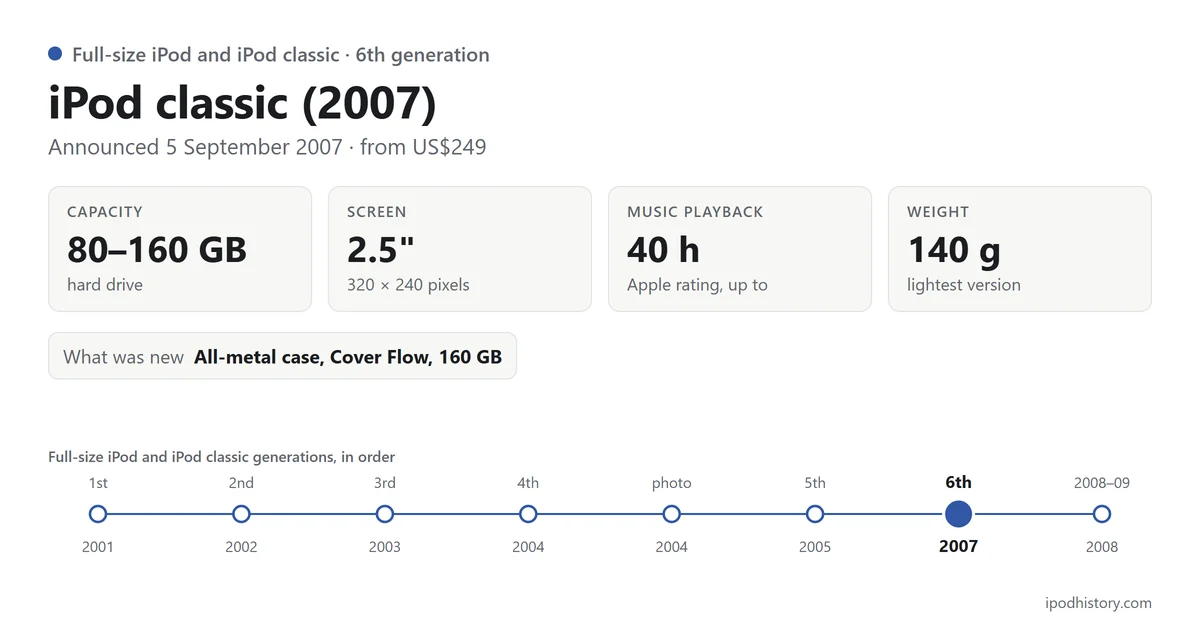
From 5 September 2007 the full-size iPod was sold as the iPod classic, a name that separated it from the iPod touch launched at the same event. It was the sixth generation of the design. It came in 80 GB and 160 GB versions, priced at US$249 and US$349 and available immediately worldwide in silver or black. Apple's figures put the 80 GB model at about 20,000 songs or 100 hours of video and the 160 GB model at 40,000 songs or 200 hours, with room for up to 25,000 photos in either.
A new name in 2007
From 5 September 2007 the full-size iPod was sold as the iPod classic, a name that separated it from the iPod touch launched at the same event. It was the sixth generation of the design. It came in 80 GB and 160 GB versions, priced at US$249 and US$349 and available immediately worldwide in silver or black. Apple's figures put the 80 GB model at about 20,000 songs or 100 hours of video and the 160 GB model at 40,000 songs or 200 hours, with room for up to 25,000 photos in either.
Metal case and screen
Earlier full-size iPods had a plastic front; the iPod classic paired an anodised aluminium front with a polished stainless steel back, which Apple called an all-metal enclosure. Silver replaced the familiar white, and the black version had a black front plate and wheel. Both capacities measured 103.5 by 61.8 mm, but the 80 GB model was 10.5 mm deep and weighed 140 g, against 13.5 mm and 162 g for the 160 GB model. The 2.5-inch colour LCD kept a 320 × 240 resolution, at 163 pixels per inch.
Software and Cover Flow
The interface was redrawn with artwork on the upper menu levels and album thumbnails in lists, and Cover Flow allowed browsing by album cover. Three games, iQuiz, Vortex and Klondike, came preinstalled. In its first review, on 13 September 2007, Macworld found the interface sluggish, with pauses when returning to the main menu, and judged Cover Flow of little use without album art. After software update 1.0.1, a second Macworld review on 25 September reported that the slow screen redraws had disappeared.
Battery, video and connections
Apple rated the 80 GB model at up to 30 hours of music or five hours of video, and the 160 GB model at up to 40 and seven hours. Syncing ran over USB 2.0 through the dock connector, with Mac OS X 10.4.8 or Windows XP SP2 or Vista and iTunes 7.4 required. Video reached a television only through the dock connector, using component or composite AV cables sold separately. Apple said video output required accessories supporting the new models' enhanced video capabilities; of the existing video accessories Macworld tried, only Apple's Universal Dock worked. On 9 September 2008 a single 120 GB model replaced both versions.
Specifications
| Announced | 5 September 2007 |
|---|---|
| Launch price (US) | US$249 (80 GB), US$349 (160 GB) |
| Capacity | 80 GB or 160 GB hard drive — about 20,000 or 40,000 songs |
| Display | 2.5-inch colour LCD, 320 × 240 pixels at 163 ppi |
| Battery | 80 GB: up to 30 hours of music, 5 hours of video; 160 GB: 40 and 7 hours |
| Connectors | Dock connector (USB 2.0, component and composite video), 3.5 mm headphone jack |
| Size | 103.5 × 61.8 × 10.5 mm (4.1 × 2.4 × 0.41 in); 160 GB: 13.5 mm (0.53 in) deep |
| Weight | 140 g (4.9 oz); 160 GB: 162 g (5.7 oz) |
| Colours | Silver or black; anodised aluminium front, polished stainless steel back |
| Works with | Mac OS X 10.4.8 or later; Windows Vista or XP (SP2); iTunes 7.4 |
| Model number | A1238 |
Figures from Apple's published technical specifications. Where Apple lists only inches and ounces, metric values are converted and rounded.
How to identify it
- An all-metal case: anodised aluminium front in silver or black, polished steel back.
- Model number A1238, shared with the 2008 and 2009 iPod classic — this one is the 80 GB or 160 GB version.
- The 160 GB model of 2007 is thicker (13.5 mm) than the slim 160 GB model of 2009 (10.5 mm).
- Serial number ends in Y5N, YMU, YMV or YMX.
Where to find the model number and serial number: how to identify a used iPod.