Original iPod, 1st Generation (2001): History and Specs
Announcement, launch and price
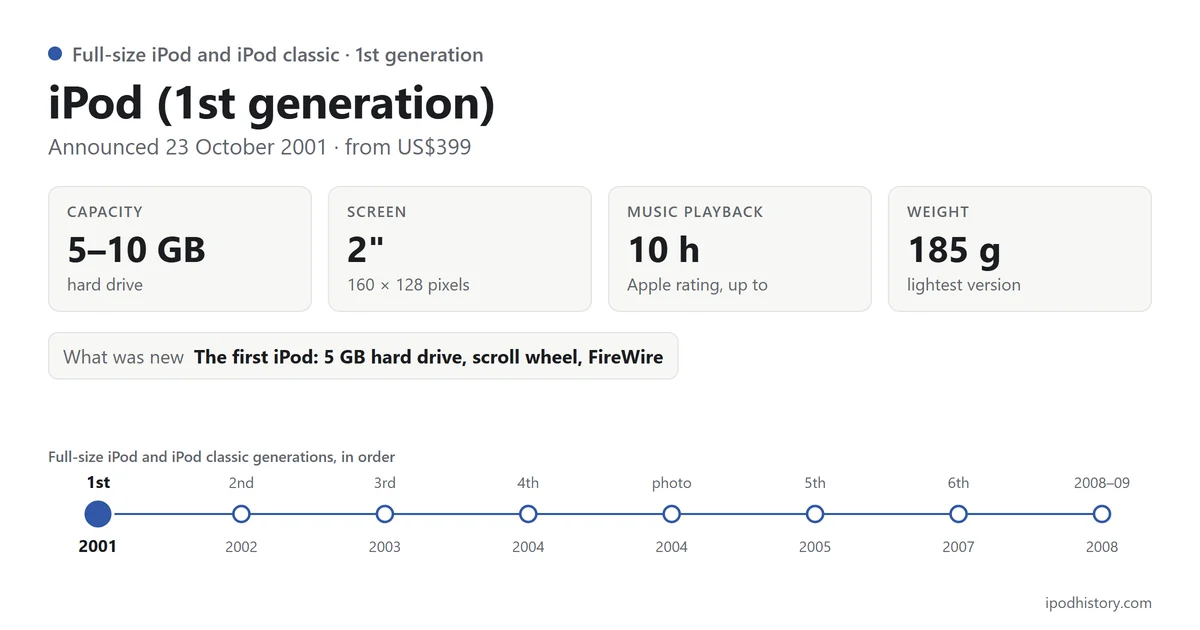
The original iPod was announced on 23 October 2001. It went on sale on Saturday 10 November 2001 through the Apple Store online, Apple's retail stores and authorised resellers, at a suggested price of US$399. Apple's launch material described a 5 GB hard drive holding up to 1,000 CD-quality songs. At Macworld Expo Tokyo in March 2002 Apple added a 10 GB model holding about 2,000 songs for US$499, kept the 5 GB model at US$399, and released free software that let the iPod store up to 1,000 contacts.
Hardware
The case measured 4.02 by 2.43 by 0.78 inches (102 × 61.8 × 19.9 mm), and the player weighed 6.5 ounces (185 g). Storage came from a 1.8-inch Toshiba hard drive, the MK5002MAL, at a time when other hard-drive players used larger 2.5-inch drives. The 2-inch monochrome LCD had a resolution of 160 × 128 pixels and a white LED backlight. Navigation used a mechanical scroll wheel that accelerated through long lists, a centre select button and four buttons arranged around the wheel. A FireWire (IEEE 1394a) port handled both syncing and charging; Apple said a whole CD transferred in under 10 seconds, and the iPod could also be used as a FireWire hard disk. The 1,200 mAh lithium-polymer battery was rated at 10 hours of playback, with up to 20 minutes of skip protection. Supported formats were MP3 at up to 320 kbps, MP3 VBR, WAV and AIFF.
Mac-only software
The iPod required a Mac with built-in FireWire running Mac OS 9.2 or later or Mac OS X 10.1 or later. It shipped with iTunes 2, whose Auto-Sync feature copied songs and playlists to the player whenever it was connected. This model was not compatible with Windows.
Development, reception and successor
Jon Rubinstein, Apple's hardware chief, had found the Toshiba drive during a meeting with a supplier in Japan, and Tony Fadell joined the project in 2001 as an independent contractor. Working with PortalPlayer, the team developed the iPod in less than a year. The name was proposed by freelance copywriter Vinnie Chieco. Early reaction was divided: The Register judged the iPod expensive but a strong choice for Mac owners, while other commentators doubted that a US$399 Mac-only player would sell. On 17 July 2002 Apple announced the second generation, which replaced the mechanical wheel with a solid-state touch wheel and added Windows versions, with 10 GB and 20 GB models at US$399 and US$499 and the 5 GB model reduced to US$299.
Specifications
| Announced | 23 October 2001; on sale 10 November 2001 |
|---|---|
| Launch price (US) | US$399 (5 GB); US$499 for the 10 GB model added in March 2002 |
| Capacity | 5 GB or 10 GB hard drive — about 1,000 or 2,000 songs |
| Display | 2-inch monochrome LCD, 160 × 128 pixels, white LED backlight |
| Controls | Mechanical scroll wheel that turns, with four buttons around it |
| Battery | Up to 10 hours of music |
| Connectors | FireWire 400, 3.5 mm headphone jack |
| Size | 102 × 61.8 × 19.9 mm (4.02 × 2.43 × 0.78 in) |
| Weight | 185 g (6.5 oz) |
| Works with | Mac only: Mac OS 9.2 or Mac OS X 10.1 or later, with iTunes 2 |
| Model number | M8541 |
Figures from Apple's published technical specifications. Where Apple lists only inches and ounces, metric values are converted and rounded.
How to identify it
- The wheel physically turns; Play, Menu, Next and Previous sit in a ring around it.
- A FireWire port on the top with no port cover (the second generation added one).
- Model number M8541 on the back — the only iPod whose number does not start with A.
- Capacity of 5 GB or 10 GB.
Where to find the model number and serial number: how to identify a used iPod.
Propellerheads “Take California”: The First iPod Commercial (2001)