iPod 2nd Generation (2002): History and Specs
Touch wheel models
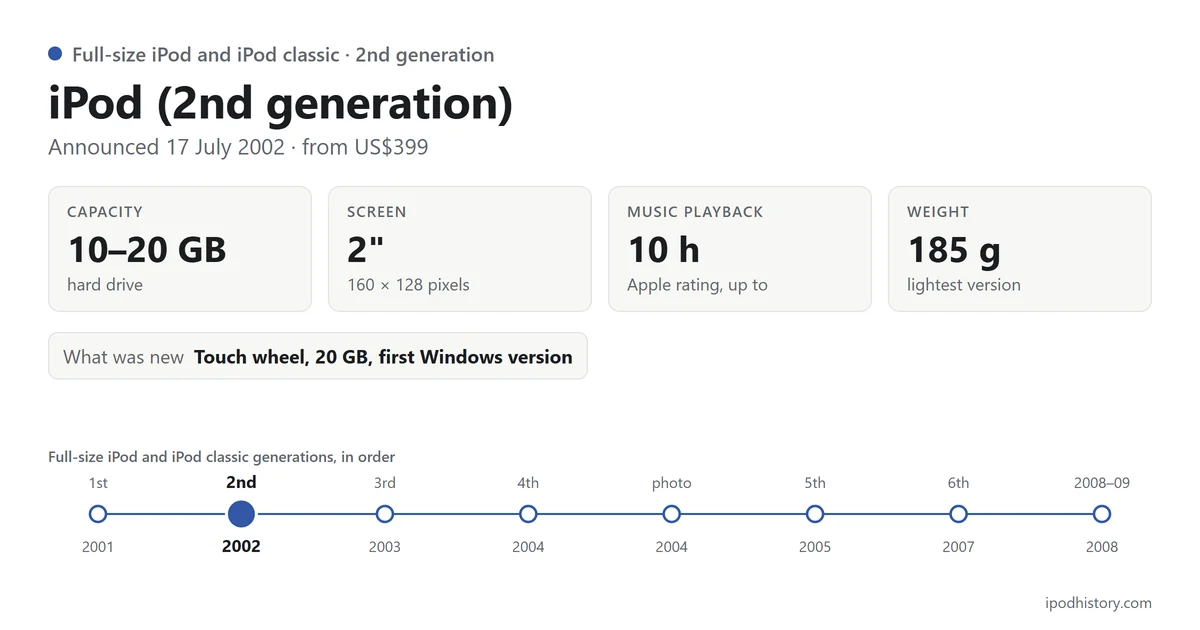
The second-generation iPod consisted of two models, 10 GB and 20 GB, unveiled at Macworld Expo in New York on 17 July 2002 and shipped from August. Their defining feature was a solid-state touch wheel, which Apple described as the first in the industry: instead of turning, it sensed the movement of a finger. The Menu, Play, Next and Previous buttons stayed in a circle around the wheel, as on the first model. Apple lists them as the iPod (Touch Wheel), model A1019. A 5 GB model sold alongside them for US$299 kept the mechanical scroll wheel of 2001.
Case, screen and battery
Outwardly they resembled the original, with a white front and a stainless steel back. Both measured 4.0 by 2.4 inches; the 10 GB model was 0.72 inch deep and weighed 6.5 ounces (185 g), while the 20 GB model was 0.84 inch deep and weighed 7.2 ounces (204 g). Smaller changes included a cover for the FireWire port, a redesigned hold switch and separate openings for the ports on the top edge. The 2-inch monochrome LCD showed 160 × 128 pixels under a white LED backlight. A 1,200 mAh lithium-polymer battery was rated at about 10 hours of playback and charged over FireWire, reaching 80 per cent in about an hour and a full charge in up to three hours.
Mac and Windows versions
Each capacity came in separate Mac and Windows versions. The Windows model came with MUSICMATCH Jukebox Plus, since iTunes still ran only on the Mac, and included a 4-pin to 6-pin FireWire adapter; it needed a PC with FireWire running Windows Me, 2000 or XP. The Mac model came with iTunes 3 for Mac OS X and required Mac OS 9.2.2 or Mac OS X 10.1.4 or later. Both connected only by FireWire, and Apple put the transfer time for a 4,000-song library at about 30 minutes, against more than 13 hours over USB.
Accessories and successor
The box held earbuds, a power adapter, a FireWire cable, a carrying case and a wired remote. The remote plugged into the headphone socket, using an extra ring of contacts around it. The touch-wheel design was succeeded on 28 April 2003 by the third-generation iPod, which replaced the FireWire port with a 30-pin dock connector and moved the remote to a separate four-pin jack.
Specifications
| Announced | 17 July 2002; shipped from August 2002 |
|---|---|
| Launch price (US) | US$399 (10 GB), US$499 (20 GB) |
| Capacity | 10 GB or 20 GB hard drive — about 2,000 or 4,000 songs |
| Display | 2-inch monochrome LCD, 160 × 128 pixels |
| Controls | Touch-sensitive wheel that does not turn, with four buttons around it |
| Battery | Up to 10 hours of music |
| Connectors | FireWire 400 with a port cover, 3.5 mm headphone jack with remote support |
| Size | 102 × 61 × 18.3 mm (4.0 × 2.4 × 0.72 in); 20 GB: 21.3 mm (0.84 in) deep |
| Weight | 185 g (6.5 oz); 20 GB: 204 g (7.2 oz) |
| Works with | Mac (Mac OS 9.2.2 or Mac OS X 10.1.4) or Windows (Me, 2000 or XP) — separate Mac and Windows versions |
| Model number | A1019 |
Figures from Apple's published technical specifications. Where Apple lists only inches and ounces, metric values are converted and rounded.
How to identify it
- The wheel looks like the first generation's but does not turn: it is touch-sensitive.
- The FireWire port on top has a cover; dock-connector models have no FireWire port at all.
- Model number A1019; capacity 10 GB or 20 GB.
- A 5 GB model sold alongside it kept the turning scroll wheel and belongs to the first generation.
Where to find the model number and serial number: how to identify a used iPod.