iPod nano 4th Generation (2008): History and Specs
A curved, nine-colour nano
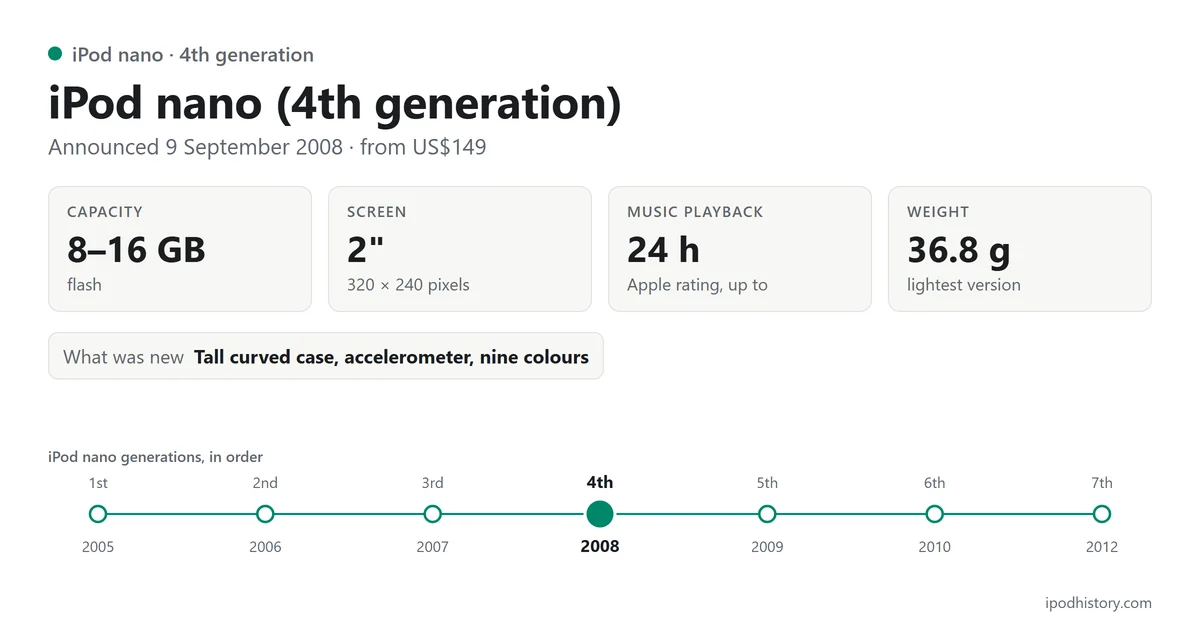
The fourth-generation iPod nano was introduced on 9 September 2008 and was available the same day. Apple described it as the thinnest iPod it had made. The curved aluminium and glass enclosure measured 90.7 × 38.7 × 6.2 mm and weighed 36.8 g, and Apple's support guide identifies the model by its taller screen and oval cross-section. It came in nine colours: silver, black, purple, blue, green, yellow, orange, pink and (PRODUCT) RED. The 8GB model, holding about 2,000 songs, cost US$149, and the 16GB model, holding about 4,000 songs, cost US$199.
Motion and playlist features
The 2-inch display had 320 × 240 pixels at 204 ppi. A built-in accelerometer reacted to movement: turning the player sideways switched to Cover Flow for browsing album art, and shaking it lightly started shuffled playback. The Genius feature, introduced with iTunes 8, created a playlist of songs from the library that went well with a chosen track, which could be refreshed or saved. Spoken menus read out menu names, song titles and artists, and Nike + iPod support was built in. Voice memos could be recorded when a compatible microphone was attached.
Battery and connections
Apple rated playback at up to 24 hours of music or 4 hours of video, with a full charge taking about three hours. Controls were the Click Wheel and a hold switch. Connections were the dock connector, which carried USB 2.0 syncing and charging, and a 3.5 mm headphone jack. FireWire charging was no longer supported, so some older dock accessories could not charge it. Video in H.264 or MPEG-4 format played at up to 640 × 480, and could be sent to a television through the dock with AV cables sold separately. It required Mac OS X 10.4.11 or later or Windows Vista or XP with Service Pack 3, plus iTunes 8.
Successor
The fifth-generation iPod nano replaced it on 9 September 2009, keeping a similar shape but adding a video camera, an FM radio and a 2.2-inch screen.
Specifications
| Announced | 9 September 2008, available the same day |
|---|---|
| Launch price (US) | US$149 (8 GB), US$199 (16 GB) |
| Capacity | 8 GB or 16 GB flash memory — about 2,000 or 4,000 songs |
| Display | 2-inch colour LCD, 320 × 240 pixels at 204 ppi |
| Battery | Up to 24 hours of music or 4 hours of video |
| Sensors | Accelerometer, used by Shake to shuffle |
| Connectors | Dock connector, 3.5 mm headphone jack |
| Size | 90.7 × 38.7 × 6.2 mm (3.6 × 1.5 × 0.24 in) |
| Weight | 36.8 g (1.3 oz) |
| Colours | Nine colours |
| Works with | Mac OS X 10.4.11 or later; Windows Vista or XP (SP3) |
| Model number | A1285 |
Figures from Apple's published technical specifications. Where Apple lists only inches and ounces, metric values are converted and rounded.
How to identify it
- Tall screen and a curved surface: the case is oval when seen from the top or bottom.
- It has an accelerometer: shaking it shuffles the music.
- Model number A1285; nine colours.
Where to find the model number and serial number: how to identify a used iPod.