iPod nano 3rd Generation (2007): History and Specs
The first nano to play video
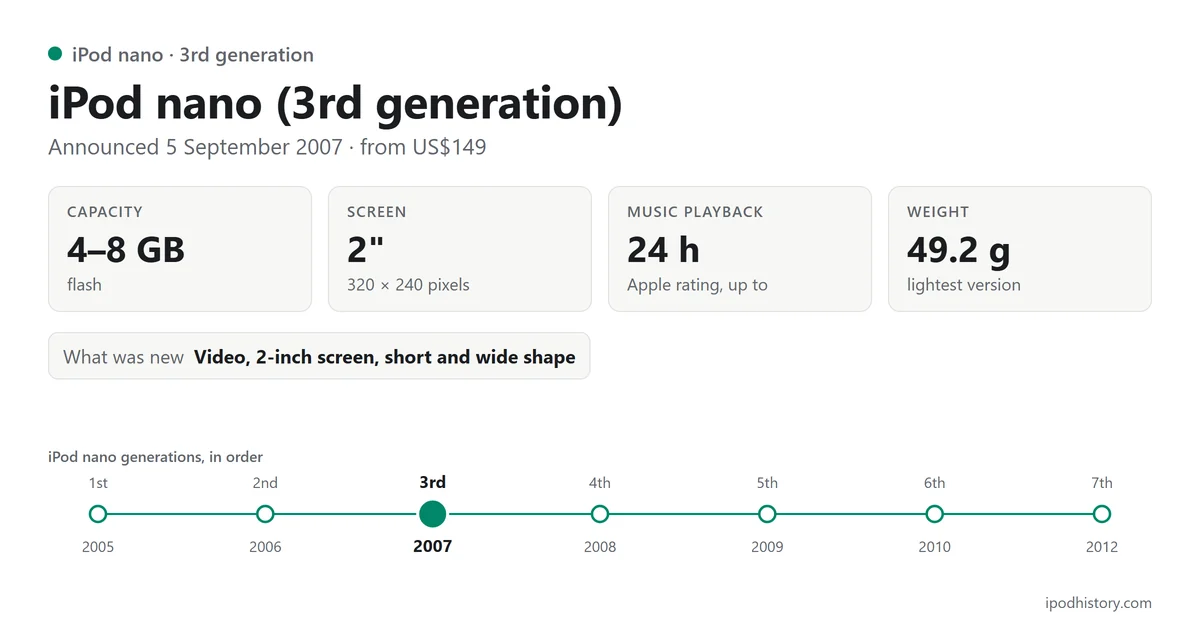
The third-generation iPod nano went on sale on 5 September 2007, the day it was announced, and was the first nano able to play video. It was built around a 2-inch colour LCD of 320 × 240 pixels at 204 ppi, the same resolution as the iPod with video. Apple said the screen was 65 per cent brighter than the previous nano's and had the highest pixel density it had produced. The body became shorter and wider, measuring 69.8 × 52.3 × 6.5 mm and weighing 49.2 g, in anodised aluminium and polished stainless steel.
Capacities, colours and battery
Two flash capacities were offered. The 4GB model held about 1,000 songs, cost US$149 and came only in silver; the 8GB model held about 2,000 songs and cost US$199 in silver, black, blue, green or a (PRODUCT) RED special edition. A pink 8GB version followed on 22 January 2008 at the same price. Battery life was quoted as up to 24 hours for music and 5 hours for video; a fast charge reached 80 per cent in about 1.5 hours, and a full charge took about three.
Interface, games and video output
The Click Wheel stayed but became thinner, and the redesigned software displayed album artwork and photos. Cover Flow, carried over from iTunes, let users scroll through albums by their covers. Three games came preinstalled: iQuiz, Vortex and Klondike. Tetris, Ms. PAC-MAN and Sudoku were announced for the iTunes Store later that month, but games bought for the fifth-generation iPod did not run on the new model and had to be bought again. With AV cables sold separately, video could also be shown on a television via the dock connector, and syncing used USB 2.0.
Reception and successor
In Macworld's review, published on 12 September 2007, Dan Frakes recorded nearly 31 hours 20 minutes of music and just over 5 hours 20 minutes of video playback, beyond Apple's ratings. He listed as drawbacks the shiny back, which scratched more easily than the earlier anodised finish, incompatibility with some dock-connector accessories and the need to repurchase games, and found Cover Flow slow with large collections of album art. The fourth-generation iPod nano, with a tall curved body and an accelerometer, replaced it on 9 September 2008.
Specifications
| Announced | 5 September 2007, on sale the same day |
|---|---|
| Launch price (US) | US$149 (4 GB), US$199 (8 GB) |
| Capacity | 4 GB or 8 GB flash memory — about 1,000 or 2,000 songs |
| Display | 2-inch colour LCD, 320 × 240 pixels at 204 ppi |
| Battery | Up to 24 hours of music or 5 hours of video |
| Connectors | Dock connector (USB 2.0, component and composite video), 3.5 mm headphone jack |
| Size | 69.8 × 52.3 × 6.5 mm (2.75 × 2.06 × 0.26 in) |
| Weight | 49.2 g (1.74 oz) |
| Colours | 4 GB silver; 8 GB silver, black, blue, green, pink or (PRODUCT) RED |
| Works with | Mac OS X 10.4.8 or later; Windows Vista or XP (SP2); iTunes 7.4 |
| Model number | A1236 |
Figures from Apple's published technical specifications. Where Apple lists only inches and ounces, metric values are converted and rounded.
How to identify it
- Short and wide, with a wider screen than earlier nanos — and it plays video.
- The Hold switch is on the bottom.
- Model number A1236; serial number ends in YOP, YOR, YXR, YXT, YXV or YXX.
Where to find the model number and serial number: how to identify a used iPod.